
80% more progress in twelve weeks.
That is the result of the TACTIC study, a randomised controlled trial: people who practised with myReha on top of standard care after a brain injury improved clearly more in cognition and language.
CERAD-plus total score
Group means, higher is better
+80%
greater improvement
myReha + standard care
+0.54
Standard care only
+0.30
After the clinic, therapy is often missing.
After an acquired brain injury, such as a stroke or a traumatic brain injury, many people struggle with memory, attention or language (Figure 1).1, 2
Up to 64%
have cognitive impairment after a stroke
About 1 in 3
develop aphasia
What helps most is a lot of regular practice. After discharge, however, many receive only about one hour of therapy a week, often a single 45-minute session. At least three hours are recommended (Figure 2).3, 4
Therapy per week after discharge
Recommended
at least 3 hours
Usual
about 1 hour
With myReha
therapy plus app
An app can close this gap, if it works. That is exactly what we tested: in a randomised controlled trial, the gold standard of clinical research.
How the study ran.
Adults took part in the TACTIC study whose brain injury had happened at least four weeks earlier and who were impaired in at least one area of cognition or language. They came from two hospitals in Vienna, Klinik Floridsdorf and St. John's Hospital.
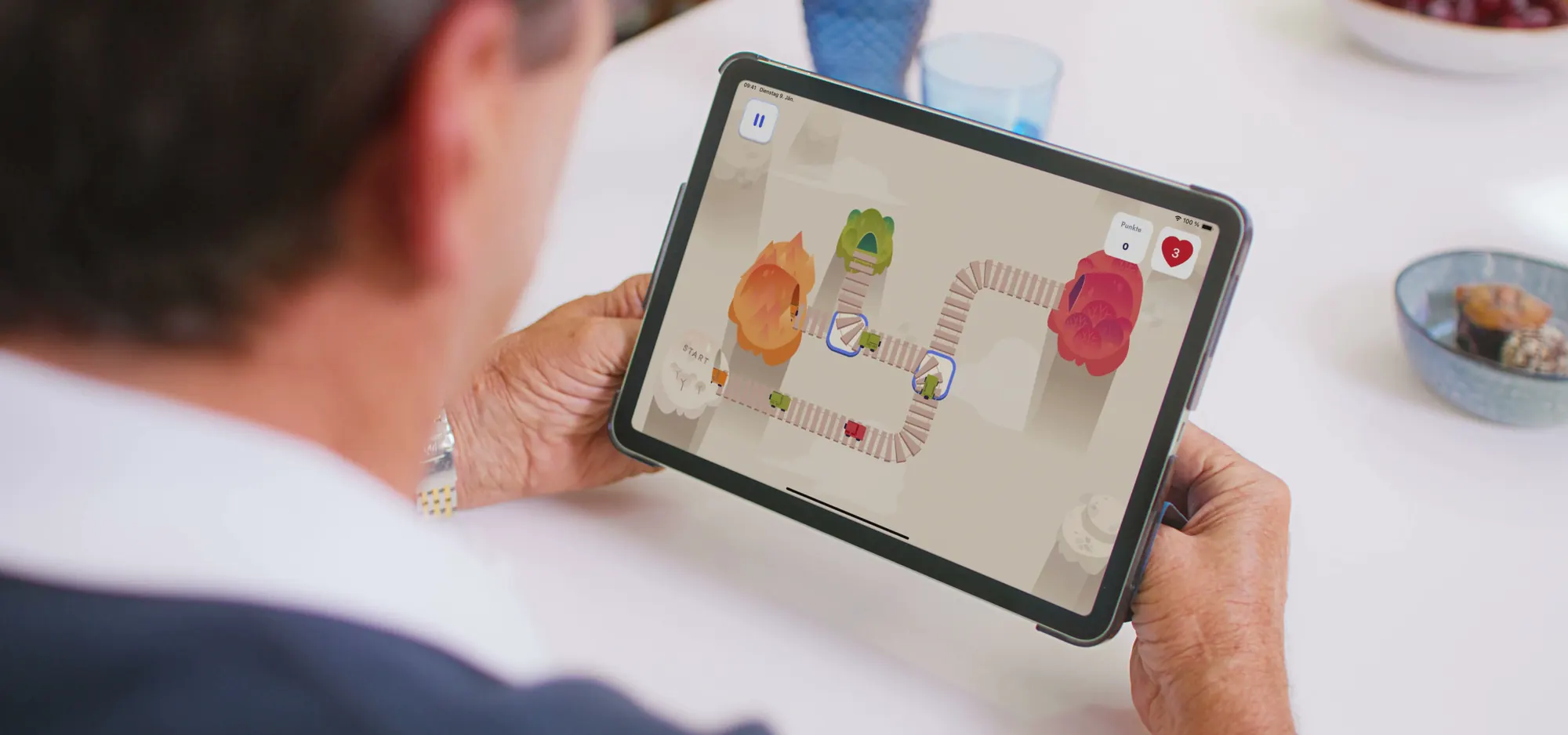
They were randomly assigned to one of two groups (Figure 3). One practised at home with myReha on a tablet for twelve weeks, on top of usual care. The other received usual care only.
88
assessed for eligibility
30
not eligible or declined
58
randomised
27
myReha + standard care
6
lost to follow-up
21
analysed
31
standard care only
4
lost to follow-up
27
analysed
Each person decided how often and how long to practise. The app adjusts the difficulty continuously and gives immediate feedback. No guidance from therapists was needed.
Everyone was tested before the start and after twelve weeks with the CERAD-plus battery, an established test of memory, language, visuospatial skills, mental flexibility and speed (Figure 4).5 Assessors did not know which group a person was in.
Memory
Remembering word lists and figures
Language
Naming, verbal fluency
Visuospatial skills
Copying figures
Flexibility
Switching between tasks
Speed
Working fast and accurately
At the start, both groups were comparable in age, sex, cause of the brain injury and time since the event. Most had had an ischaemic stroke (86% and 74%). Only about one in five received additional therapy in a practice during the study (24% and 19%).
The result: 80% more progress.
Both groups improved over the twelve weeks, but the myReha group clearly more (Figure 5). Its CERAD-plus total score rose by 0.54, the control group's by 0.30: an improvement about 80% larger. The difference in change between the groups is statistically significant (group × time: β = −0.24, 95% confidence interval −0.47 to −0.01, p = 0.049).
- myReha + standard care+0.54
- Standard care only+0.30
- before the startafter 12 weeks
The values are z-scores: 0 is the average of the norm sample, minus 1 is one standard deviation below it. The myReha group started slightly lower (−1.16 versus −0.82; not significant) and caught up within twelve weeks.
More practice, more progress.
In the myReha group, progress was closely tied to practice time: those who spent more time with the app improved more (Figure 6). This holds after accounting for how impaired someone was at the start and whether they received additional therapy in a practice (partial Spearman correlation, ρ = 0.74, p < 0.001, n = 21).
ρ = 0.74strong association
This fits a basic principle of neurorehabilitation: the brain learns through repetition and intensity.6 Together with the group comparison, this suggests that the practice itself contributed to the progress.
With and without therapy in a practice.
Only ten of the 48 people received therapy in a practice during the study, five in each group. That allows a look at what myReha does on its own (Figure 7).
- Therapy in a practice + myReha5 people+0.64
- myReha alone16 people+0.53
- Therapy in a practice alone5 people+0.42
- Neither22 people+0.25
The averages line up like a staircase: progress was largest with practice therapy and myReha, then with myReha alone, then with practice therapy alone, and smallest with neither. The subgroups are small and the differences within the groups are not statistically significant.
Ahead in nine of eleven tests.
We also looked at the individual subtests, each time only in people whose performance there was impaired at the start. In nine of eleven tests the myReha group improved more, in two the control group did (Figure 8).
- Mini-Mental State Examination (MMSE)n 14 / 14+1.66+0.12
- Word list recognitionn 6 / 6+1.84+0.98
- Naming (Boston Naming Test)n 10 / 8+0.84+0.17
- Trail Making Test Bn 10 / 13+1.09+0.50
- Figure copyn 6 / 3+1.68+1.09
- Semantic fluency (animals)n 15 / 16+0.86+0.34
- Word list learningn 13 / 14+0.78+0.49
- Phonemic fluency (S words)n 11 / 13+0.42+0.32
- Trail Making Test An 9 / 8+0.39+0.36
- Word list recalln 9 / 12+0.66+1.06
- Figure recalln 8 / 9+1.45+1.87
n = People per group (myReha / Control)
Practise with myReha, as often as feels right.
myReha is a certified medical device (CE MDR class IIa). With many health insurers, the app is free for you.
Do you work in a clinic or practice?For clinicsFor practices
The study at a glance
- Design
- Randomised controlled, two parallel groups, 1:1 allocation
- Period
- March 2023 to December 2024
- Sites
- Klinik Floridsdorf and St. John's Hospital, Vienna
- Participants
- 58 randomised, 48 analysed (21 myReha, 27 control)
- Intervention
- 12 weeks of myReha at home, on top of standard care
- Primary outcome
- CERAD-plus total score (z-score)
- Analysis
- Linear mixed-effects model, group × time
- Ethics
- Ethics Committee of the City of Vienna
- Funding
- No specific funding
- Status
- Conference abstract 2025
The study
Efficacy of a Digital Therapy App for Cognitive and Language Rehabilitation after Acquired Brain Injury: Results from a Randomized Controlled Trial
Theresa Bloder, Philipp Schöllauf, Burak Bastürk, Nicolas Calleja-Dincer, Gerhard Ellmer, Stefan Krebs, Peter Lackner
- nyra health GmbH
- Karl Landsteiner Institute for Clinical Research in Acute Neurology
- Vienna Healthcare Group, Klinik Floridsdorf, Department of Neurology
- St. John's Hospital, Department of Neurology
Sources
- 1Kaddumukasa, M. N. et al. (2023). Prevalence and predictors of post-stroke cognitive impairment among stroke survivors in Uganda. BMC Neurology, 23(1). doi.org/10.1186/s12883-023-03212-8
- 2Enderby, P. & Sutton, L. (2020). Where are we now with aphasia after stroke? Annals of Indian Academy of Neurology, 23(8), S57–S62. doi.org/10.4103/aian.AIAN_666_20
- 3Cavanaugh, R. et al. (2021). Is There a Research-Practice Dosage Gap in Aphasia Rehabilitation? American Journal of Speech-Language Pathology, 30, 2115–2129.
- 4Brady, M. C. et al. (2025). European Stroke Organisation (ESO) guideline on aphasia rehabilitation. European Stroke Journal. doi.org/10.1177/23969873241311025
- 5Schmid, N. S. et al. (2014). The Extension of the German CERAD Neuropsychological Assessment Battery with Tests Assessing Subcortical, Executive and Frontal Functions Improves Accuracy in Dementia Diagnosis. Dementia and Geriatric Cognitive Disorders Extra, 4(2), 322–334. doi.org/10.1159/000357774
- 6Kleim, J. A. & Jones, T. A. (2008). Principles of experience-dependent neural plasticity: Implications for rehabilitation after brain damage. Journal of Speech, Language, and Hearing Research, 51(1). doi.org/10.1044/1092-4388(2008/018)